Squeezing Phase Transitions and Entanglement Generation
In Plain English
At the quantum level, particles can become "entangled," sharing a deep connection that Albert Einstein famously referred to as "spooky action at a distance."
This entanglement is the critical resource allowing quantum systems to perform better than classical systems. In particular, it allows to build more precise sensors. In this work, we looked at how groups of quantum spins interacting over long distances build up entanglement useful for improved sensitivity in measurements.
We discovered that these systems can shift between two distinct phases. In the "fully collective" phase, all the spins perfectly synchronize—much like a swarm of fireflies perfectly synchronizing their flashes. More surprisingly, we discovered a "partially collective" phase. Here, the spins don't completely synchronize, but the system still manages to follow strict universal laws, similar to how we understand familiar transitions like ice melting into water.
Research Summary
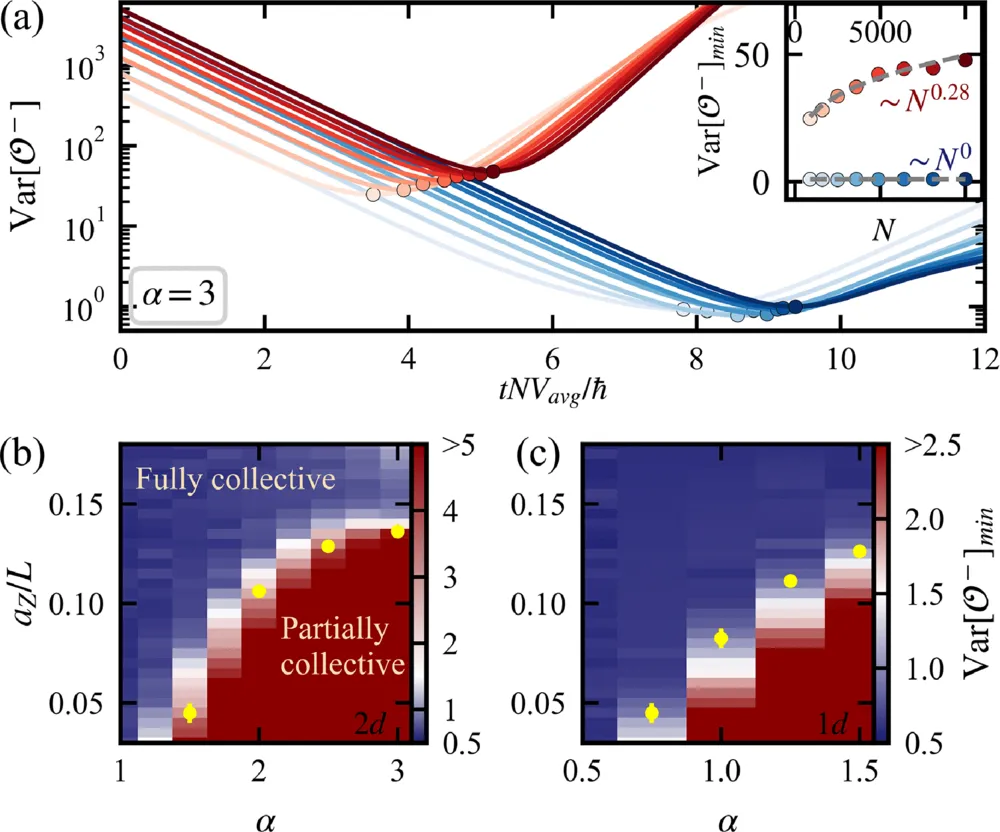
This project investigates phase transitions in the nonequilibrium dynamics of power-law interacting spin-$1/2$ bilayer XXZ models. Our analytical models demonstrate that these systems, governed by inverse power-law interactions falling off as $1/r^{\alpha}$, undergo a novel "Squeezing Phase Transition."
We successfully mapped a collective phase allowing for Heisenberg-limited entanglement generation, and a partially collective phase that exhibits universal scaling of squeezing dynamics dependent on fundamental system parameters and a divergent timescale. We further demonstrated that applying spatio-temporal control via localized fields can significantly increase the generated entanglement.