Scalable Entanglement in Multi-Level (Qudit) Spin Systems
In Plain English
Most quantum technologies are built from qubits, quantum objects with just two states, much like a coin that can only land heads or tails.
Many of the atoms and molecules used in today's quantum simulators, however, naturally come with more than two states. These multi-level systems, called qudits, are more like a die than a coin: their richer internal structure allows forms of entanglement that simply do not exist for qubits.
Entanglement can make a measurement more precise than any classical strategy allows, but generating it at scale is hard when particles mostly interact with their near neighbors. In this work, we found ways for arrays of interacting qudits, such as Rydberg atoms held in optical tweezers, polar molecules, or magnetic atoms, to build up large amounts of entanglement useful for quantum sensors, in some cases reaching the ultimate precision allowed by quantum mechanics.
Research Summary
Spin squeezing, the redistribution of quantum noise from one spin quadrature to another, is one of the most established routes to entanglement-enhanced metrology. Most work so far has focused on effective two-level, spin-1/2 systems. Yet Rydberg atoms, polar molecules, magnetic atoms and alkaline-earth atoms natively host more than two internal levels, whose larger operator algebra offers nematic (quadrupolar) quadratures absent for qubits.
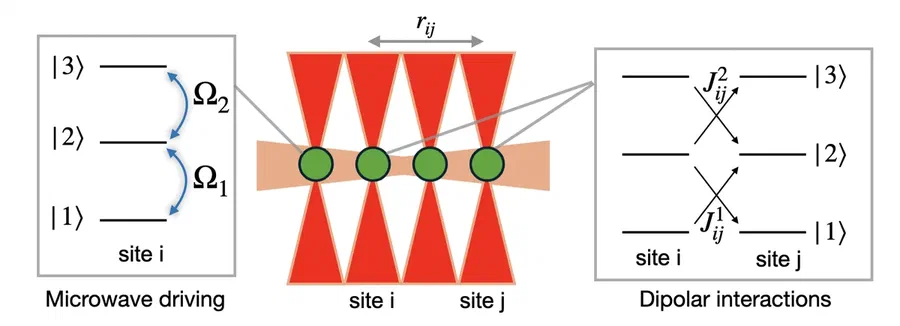
We showed that a three-level (spin-1) system, naturally realized with dipole-interacting Rydberg atoms in optical tweezer arrays, generates scalable spin-nematic squeezing. In the spin-quadrupolar basis, the interactions decompose into effective SU(2) subspaces. For symmetric interactions the dynamics maps onto one-axis twisting within bright and dark manifolds, with squeezing that improves with system size for both all-to-all and two-dimensional dipolar couplings, while antisymmetric interactions combined with a microwave drive realize a distinct two-axis countertwisting mechanism.
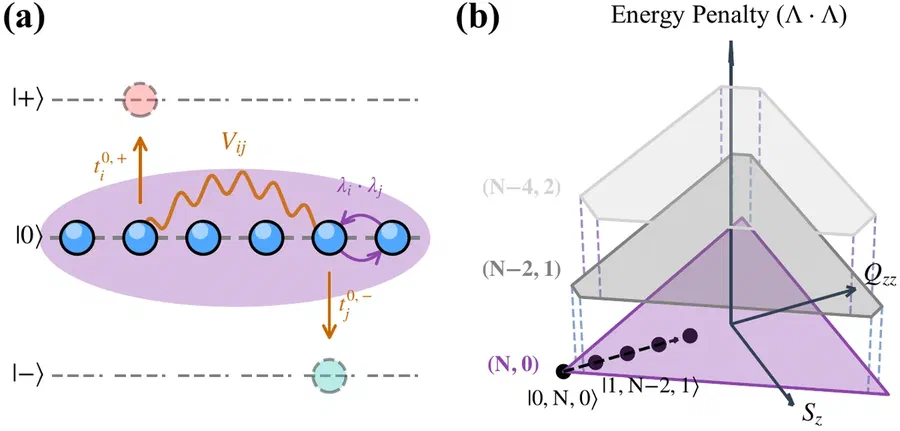
Without all-to-all connectivity, entanglement generation generally suffers from leakage into non-collective excitations, which destroys Heisenberg scaling. We identified a general gap-protection mechanism for qudits: local su(D) exchange interactions open an energy gap that protects the fully symmetric collective manifold. For spin-changing pair creation, which brings the spin-nematic squeezing known from spinor Bose-Einstein condensates to spatially extended lattices, this achieves Heisenberg-limited squeezing, ξ² ∝ 1/N, in one to three dimensions and for any power-law exponent, and remains robust to site-dilution disorder.
These results provide a practical pathway toward scalable, Heisenberg-limited qudit entanglement in arrays of polar molecules, magnetic atoms and Rydberg atoms. Qudit platforms in Rydberg arrays are also the subject of our DOE Genesis Mission project on AI-driven control and optimization.