Emergent Topology and Dipolar Spin Ladders
In Plain English
Developing materials for quantum computing often requires scientists to engineer or fine-tune parameters to achieve the desired properties. However, sometimes nature takes a shortcut.
In this research, we observed that by placing bosonic atoms into a specific "ladder" formation and letting them interact strongly with one another, highly complex topological behaviors naturally emerged on their own.
This means we can generate sophisticated quantum behaviors and edge effects simply by leveraging natural particle interactions, rather than relying on difficult, artificial engineering.
Research Summary
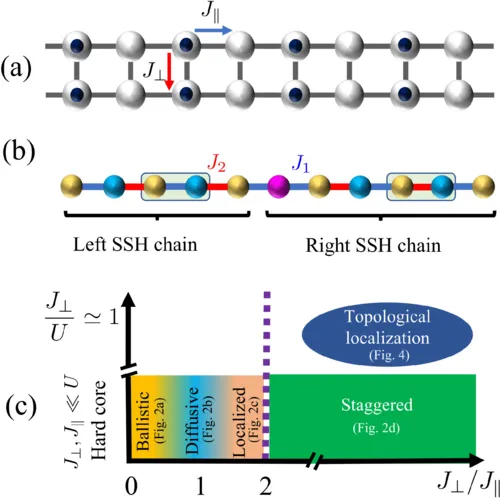
This body of work explores the quantum many-body dynamics of bosonic atoms within two-leg ladders exhibiting strong on-site contact interactions. We discovered that singlon defects within this architecture can localize due to an emergent topological model.
This phenomenon effectively creates Su-Schrieffer-Heeger (SSH) chains and zero-energy edge modes organically. Furthermore, by investigating relaxation in dipolar spin ladders, our group successfully identified distinct relaxation regimes—ranging from fully ergodic states to metastable configurations analogous to false-vacuum decay—arising from the interplay between intra- and interleg interactions.